Next to the big names in the market, a brand can feel small. They have bigger budgets, bigger shelves and bigger campaigns. So the first reaction is to look bigger: a louder logo, more posts, more ads, sometimes a full rebrand.
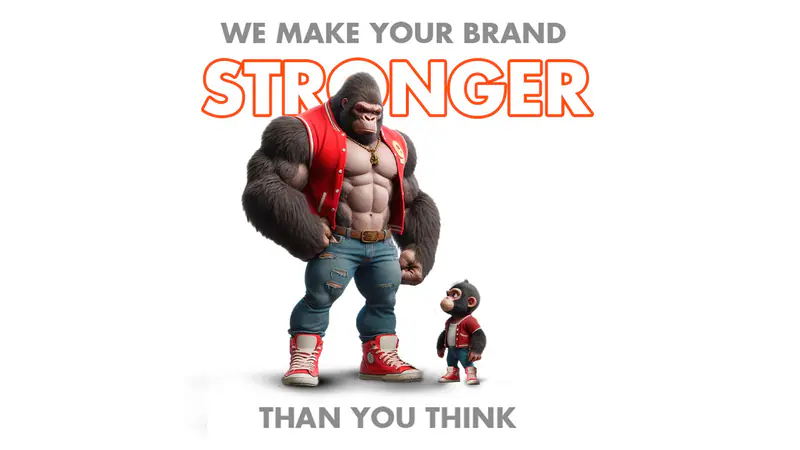
The line on the image says “we make your brand stronger than you think”. We mean it in two ways. Most brands are already stronger than their owners think in one or two places, often a colour, a bottle or a habit customers love, and weaker than they think somewhere else. Making a brand stronger starts with knowing which is which. This article is a way to find out, with a scorecard, a simple check and a worked example.
In short: A brand is strong when customers recognise it, understand what it stands for, choose it at a fair price, and find that the experience keeps the promise. Size helps, but these four layers are what make a smaller brand chosen over a bigger one. Find the weakest layer first, fix it, keep what already works, and only then spend on being louder.
What “strong” actually means
Brand strength is not a feeling and it is not a follower count. Kevin Lane Keller's work on customer-based brand equity, starting with his 1993 paper in the Journal of Marketing, describes it as the difference a brand's name makes to how customers respond. Same product, same price: does the name make people more likely to notice it, trust it, choose it and come back? If it does, the brand has equity. If customers would react the same way to an unbranded version, it does not yet.
Byron Sharp's How Brands Grow (2010) adds a practical point for smaller brands: buyers do not think about brands much. They choose what comes to mind easily and what is easy to find. So brands grow by being easy to recognise and easy to remember, through consistent distinctive assets like a colour, a shape or a sound, used the same way for years. That is good news. Consistency costs very little, and big competitors often waste it by changing their look every season.
The four layers of a strong brand
1. Recognised: people know it is you before they read the name
This is the base. Customers who see the pack, the post or the shopfront know whose it is. It depends on a few assets used without exception. Signs of weakness: each campaign looks different, customers describe you as “the one next to…” and mix you up with a competitor.
2. Understood: they can say what it stands for in one sentence
This is the position. Al Ries and Jack Trout's Positioning (1981) made the point that a brand wins by owning one clear idea in the customer's mind, not several vague ones. The test is simple: ask customers why they chose you. If the answers repeat, the position is landing. If they scatter, the brand is saying too many things, or nothing in particular.
3. Chosen: it wins at a fair price
A strong brand does not need a discount to be picked. Signs of weakness: sales come only with offers, customers compare you line by line with a cheaper option, and the sales team spends its time defending the price.
4. Proven: the experience keeps the promise
Every promise is tested at the counter, on the phone, in the box and after the sale. When the experience matches the message, customers start telling the story for you. When it does not, marketing makes the gap more visible, not smaller.
A brand strength scorecard
Score each layer honestly from what customers do, not from what the team believes. The weakest row is usually the cheapest place to start.
| Layer | Quick test | Weak sign | Strong sign |
|---|---|---|---|
| Recognised | Hide the logo. Do customers still know it is you? | They guess a competitor | They name you from a colour or shape |
| Understood | Ask ten customers why they chose you | Ten different answers | One reason repeats |
| Chosen | How often is a discount asked for before buying? | Most of the time | Rarely |
| Proven | Do buyers come back and recommend you? | Few repeat, few referrals | New customers mention a friend |
The brand strength check, step by step
None of these steps needs an agency or a budget. Each one produces something specific, and together they show where the brand is already strong and where it leaks.
- An asset list. Lay out everything customers see: logo, colours, pack, photos, page, shopfront, uniforms. Mark each one keep, fix or drop. The “keep” column is the strength that must not be thrown away.
- Ten customer sentences. Ask ten recent buyers to describe the brand to a friend in one sentence, and write it down word for word. This is the real position, whatever the strategy document says.
- A competitor wall. Put the main claims of four or five competitors on one page, next to yours. Circle the words everyone uses. Whatever is left is space you could own.
- A win and loss count. For the last twenty deals or enquiries, note who bought at full price, who needed a discount, and who chose someone else and why.
- A promise walk. Follow the journey as a customer, from first ad to after-sale message. List every point where the experience says something different from the brand.
- One decision. Fill in the scorecard and choose the weakest layer. Write the fix and the sign that should improve over the next three months.
A worked example
This example is hypothetical, and its numbers are only there to show the method. A skincare brand in Riyadh sells cleansers and moisturisers online and through a few pharmacies. Online, customers reorder. In pharmacies, it sits next to international names and moves slowly. The owner's plan is a new logo and a bigger launch campaign to “look premium”.
The asset list shows one strong asset: a pale blue pump bottle that customers mention by itself (“the blue bottle”). But social posts use a different colour palette each month, so the bottle rarely appears next to the name. Ten customer sentences come back with a clear pattern: seven say something like “it's gentle, my skin doesn't react”. The website says “luxury glow”.
The competitor wall shows that almost every brand on the pharmacy shelf claims glow, radiance or luxury. Gentleness for sensitive skin is mentioned by few. The win and loss count shows that online buyers rarely ask for discounts, while pharmacy staff say shoppers ask “what's the difference from this one?” and nobody has an answer.
So the brand is stronger than the owner thinks on recognition and proof, and weak on being understood. A new logo would have thrown away the blue bottle, its best asset. The fix is cheaper and narrower: own “gentle for sensitive skin” in every message, make the blue bottle the hero of every post and shelf, give pharmacy staff one sentence to say, and keep the claims to what the product can back up. The sign to watch over three months: how many new customers use the same words when asked why they bought.
Five mistakes that weaken brands
- Rebranding to feel new. It happens because the team is tired of the look long before customers are. Every change resets recognition. Change only what the scorecard says is weak, and keep the assets customers already know.
- Copying the leader's look. It feels safe to look like the brand that wins. But it makes you easy to confuse with them, and they get the credit. Look different on purpose, in the same category codes customers expect.
- Saying everything. Quality, price, service, speed, heritage, innovation. It happens because every claim seems true. A brand that says everything is remembered for nothing. Choose one idea and prove it often.
- Design before position. A beautiful identity built on an unclear position looks good and says nothing, and often has to be redone. Decide what the brand stands for first, then design it.
- Measuring strength in likes. Engagement is easy to count, so it becomes the target. Recognition, the reasons people give for buying, full-price sales and repeat purchases are closer to real strength.
When the brand is not the problem
Sometimes the scorecard is fine and sales are still weak. The product may not be good enough yet, it may be hard to find (Sharp calls this physical availability), the price structure may not work for retailers, or the market may be shrinking. In those cases brand work will not fix the numbers, and we would say so. And if what is needed is a quick flyer or a single post, a freelancer is often the faster, more sensible choice. Brand work pays off when the business plans to be around and growing for years.
How OG makes a brand stronger
We start by finding what is already working, because that is the strength most brands are about to throw away. Then we build in this order:
- Listen and audit. Customer research and a brand audit: the scorecard above, done in depth. What you get: a clear picture of where the brand is strong, where it leaks, and which assets to keep.
- Decide the position. Brand strategy and positioning. What you get: the one idea the brand will own, who it is for, and what it is compared with.
- Give it words and a look. Messaging and tone of voice, then visual identity that builds on the assets worth keeping. What you get: a system the team can use without us.
- Carry it everywhere. Packaging, website and content, so every touchpoint repeats the same idea. What you get: consistency the customer can feel.
One team does all of it, so the strategy is not lost between suppliers. Since 2013 we have worked with more than 72 brands across 9 markets, from Cairo and Dubai, and there are no fixed packages: scope follows what the scorecard shows. Some of this work is in our work.
The strongest objection
“Strong brands are for big budgets. We are small.” Budget buys reach, and reach matters. But the four layers are mostly decisions, not spending: one clear idea, a few assets used without exception, and an experience that keeps the promise. Those are often easier for a small brand, because fewer people have to agree and fewer channels have to change. A small brand that is consistent for three years can be easier to recognise than a big one that changes every season.
Built on: our brand work with more than 72 brands since 2013; Kevin Lane Keller, “Conceptualizing, Measuring, and Managing Customer-Based Brand Equity”, Journal of Marketing (1993); Byron Sharp, How Brands Grow (2010); Al Ries and Jack Trout, Positioning: The Battle for Your Mind (1981). The skincare brand is a hypothetical example.
Before closing this page
- Without the logo, which colour, shape or sound would customers still recognise as yours?
- If ten customers described the brand in one sentence, would the sentences match?
- Which claim do all competitors make, and which space is still empty?
- How many of the last twenty sales happened at full price?
- Which of the four layers is weakest today?