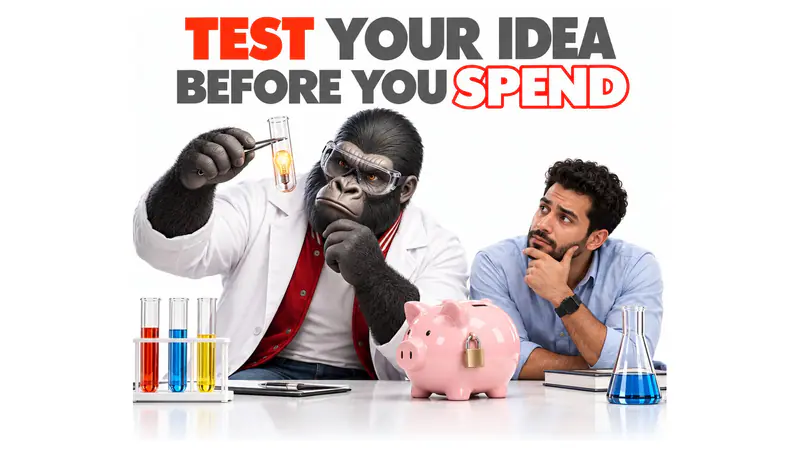
The idea feels right. Friends say they would buy it, the family is excited, and the next step already has a price on it: a shop fit-out, a first batch of stock, a logo, maybe an app. This is the moment most money is lost, not because the idea is bad, but because it was never tested by the only people whose opinion counts: strangers who would have to pay.
Testing an idea does not mean a big research project. It means finding the one or two guesses that would sink the business if they were wrong, and checking them with real behaviour, in small and cheap ways, before the large spend. This article is a way to do that, with what most founders already have: a phone, a social account and a few weeks.
In short: Every business idea is a stack of guesses: who the customer is, what problem they pay to solve, what they would pay, and how they would find and buy from you. Test the riskiest guess first. Count only evidence that costs people something, like time, a deposit or a pre-order, not compliments. Write down before the test what result means go, change or stop, then spend only on what passed.
An idea is a stack of guesses
When a founder says "the idea is good", they usually mean several different things at once. Pulling them apart is the first useful step, because each one is tested differently and each one fails differently.
- The customer: a specific group of people exists, and they can be reached.
- The problem: they feel this problem often enough, and strongly enough, to act on it.
- The alternative: what they do today is worse than what you offer, in a way they notice.
- The price: they will pay a price that covers the cost and leaves a margin.
- The channel: they can be reached at a cost that the margin can carry.
- The return: enough of them come back, or tell others, for the business to grow without paying for every sale.
Most ideas are not wrong on all six. They are wrong on one. A product people love can still fail because reaching them costs more than they spend. A cheap channel can still fail because the problem is not painful enough to pay for. The test is to find which guess is weakest while it is still cheap to find out.
Which evidence counts
The single most common testing mistake is counting the wrong things. Rob Fitzpatrick's The Mom Test (2013) puts it simply: people will lie to you to be kind, so do not ask whether they like the idea; ask about their life and what they already do. Alberto Savoia's The Right It (2019) adds the second half: the strongest data is your own, collected from people who put some "skin in the game", meaning they gave up something real to show interest. The table below ranks the usual signals from weakest to strongest.
| Signal | What it really tells you | Weight |
|---|---|---|
| "Great idea!" from friends | They like you | Ignore |
| Likes and comments on a post | The image caught attention | Very weak |
| "I would buy that" | A polite guess about the future | Weak |
| Stories of what they do today | The problem is real and how it is solved now | Useful |
| A phone number or waitlist sign-up | Some intent, at almost no cost | Medium |
| A deposit or pre-order | They will pay, at this price | Strong |
| A second order | It delivered what it promised | Strongest |
A one-page tool: the riskiest-guess sheet
Before any test, write the six guesses above for your idea in one table with four columns: the guess in one sentence, the evidence you have today (be strict, and use the table above), what it would cost if this guess were wrong, and the cheapest test that could prove it wrong. Then mark the one with the least evidence and the highest cost of being wrong. That is the guess to test first. The others can wait.
Good answers in that sheet are specific: "office workers in New Cairo who eat lunch at their desk three or more days a week". Bad answers are wide: "young people", "anyone who likes healthy food". A wide guess cannot be tested, because there is no one particular to go and ask.
The test, step by step
Each step below produces something you can see and keep. Together they usually take a few weeks and cost a small fraction of the first big spend.
- The riskiest-guess sheet. The one-page table above, with one guess circled. Output: a single sentence that starts "We believe that…" and a number that would prove it wrong.
- Ten conversations about the past. With people who match the customer description and do not know you well. Ask how they handle the problem today, the last time it happened, what they paid, and what annoyed them. Never pitch. Output: ten pages of notes, with their words in quotes.
- A pass line, written before the test. For example: "at least 10 of the first 100 people who see the offer will pay a deposit". The exact number depends on the business; what matters is writing it first, so the result cannot be argued with afterwards. Output: one line, dated.
- A smoke test. A simple offer that looks real: one page, one post or one WhatsApp catalogue, with the product, the price and a way to reserve or pre-order, shown to the right people through a small paid post or direct outreach. Output: a count of serious actions (deposits, pre-orders, booked calls), not views.
- A small manual pilot. Deliver the product by hand to the first buyers, even if it is slow and not scalable: cook in a rented kitchen, source by hand, do the service yourself. Eric Ries's The Lean Startup (2011) calls the smallest version that lets you learn a minimum viable product. Output: real costs per unit, real delivery problems, and how many buyers order a second time.
- One decision. Compare the result with the pass line. Above it: go, and spend on the next riskiest guess. Close to it: change one thing (the customer, the price, the offer) and test again. Far below: stop, or rethink the idea. Output: a written go, change or stop, with the reason.
A worked example
This example is hypothetical, and the numbers are illustrative only. A founder in Cairo wants to start a weekly lunch-box subscription for office workers: healthy meals delivered to the desk. The plan on the table is to fit out a central kitchen and build an ordering app.
The sheet. The guess with the least evidence and the highest cost is not "people want healthy food". It is "office workers will commit to a weekly plan instead of ordering day by day from delivery apps". If that is wrong, the kitchen and the app are both wasted.
The conversations. Ten talks with office workers in two business parks show that price is not the main complaint. What they dislike is choosing every day and food arriving late. Several mention that the office manager already orders lunch for meetings.
The pass line and the smoke test. Written first: "at least 15 paid first weeks from the first 150 people who message". A WhatsApp catalogue with a five-day menu, a weekly price and a small deposit is promoted in the two business parks for two weeks. Illustratively, about 150 people message, and 19 pay the deposit, so the line is passed.
The pilot. Meals are cooked in a rented kitchen during off hours and delivered by one driver. After four weeks, 11 of the 19 renew. Two office managers ask for a team plan, which was not in the original idea at all.
The decision. Go, with a change. The weekly plan works; the app does not need to exist yet, because WhatsApp handles this volume. The next riskiest guess is now the team plan for offices, which could change the whole model. The kitchen spend waits until that is tested too.
Five mistakes we see most
- Asking people you know. It happens because they are easy to reach and they answer warmly. But they are answering about you, not the product. Instead, ask strangers who match the customer description, and ask about their past, not your idea.
- Testing the product, not the purchase. Free tastings and samples feel like tests, and everyone says the food is delicious. Free tells you nothing about whether they would pay. Put a price on it, even in a test.
- Building the whole thing as the test. It happens because building feels like progress. A full shop or app is the most expensive way to learn that one guess was wrong. Test the guess with the smallest thing that can prove it wrong.
- Deciding the pass line after the result. When the result arrives, every number can be read as encouraging. Write the line before, and respect it.
- Treating one weak result as the end. A test that fails often failed on one variable: the wrong audience, the wrong price, the wrong channel. Change one thing and run it again before dropping the idea.
The strongest objection
"If I show the idea before launch, someone will copy it." It is a fair worry, but it is rarely the real risk. A smoke test shows an offer, not the recipe, the suppliers or the know-how behind it. And the copying risk is much smaller than the risk of building, at full cost, something not enough people will buy. Most ideas that fail do not fail because someone copied them. They fail because the market did not want them enough.
Honest limits
Some ideas cannot be tested cheaply. A factory, a regulated product or a large venue needs a large commitment before any customer can buy. In those cases the test moves earlier and becomes desk research, expert interviews and letters of intent from buyers, and the risk cannot be removed, only reduced. A demand test also does not prove that the operation can deliver at scale or that the numbers work long term; that needs proper financial planning, which is not our field. And if the open question is technical, whether something can be built at all, an engineer is the right first call, not a marketing agency.
How OG helps test an idea
We usually start with market and competitor research: who already serves this need, how they price it, what customers say about them, and where the gap really is. That gives you a sharper riskiest-guess sheet. Then customer research runs the conversations with people outside your circle, so the answers are not polite ones. When the idea is ready for a smoke test, we build the offer that people respond to, often a single landing page or catalogue, with a price worth testing. If the result says go, launch and market entry turns the evidence into a launch plan. At each stage you get something written you can act on, with or without us. Scope follows the need; there are no fixed packages.
If the idea has already passed its first test and the question is how to plan the first year, our article on a first-year marketing plan picks up from here.
Built on: our market and customer research work since 2013; Rob Fitzpatrick, The Mom Test (2013); Eric Ries, The Lean Startup (2011); Alberto Savoia, The Right It (2019). The lunch-box subscription is a hypothetical example, and the pass lines are illustrative, not benchmarks.
Before closing this page
- Which single guess, if wrong, would sink the idea?
- What evidence exists for it today that cost someone something?
- Who are ten strangers who match the customer, and where are they?
- What result, written today, would mean go, change or stop?
- What is the smallest thing that could be sold this month to find out?