A Ramadan campaign, a summer campaign, White Friday, a new collection with three influencers. Each one had a brief, a budget and a report. Each one moved something for a few weeks. And at the end of the year, the business is roughly where it started, and nobody can say in one sentence what the brand stands for.
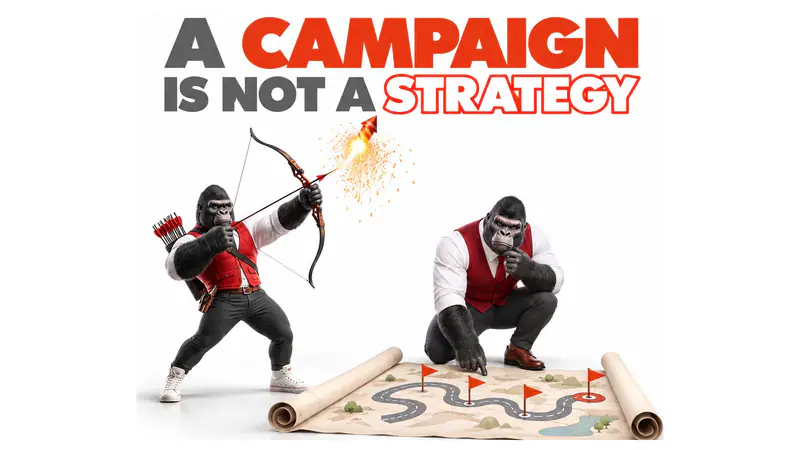
That is what happens when campaigns are asked to do the job of a strategy. A campaign is one move: a message, to an audience, for a period, through some channels. A strategy is the set of choices that decides which moves are worth making at all, and how each one builds on the last. Without it, every campaign starts from zero and pays full price for attention it does not keep.
In short: A campaign answers “what do we do this month?”. A strategy answers “what is in our way, what will we consistently do about it, and what will we refuse to do?”. The test is simple: if last year's campaigns could be shuffled into any order, or swapped with a competitor's, there was no strategy behind them. The fix is not a thick document. It is one page of choices that every campaign then serves.
What each one actually is
Richard Rumelt's Good Strategy/Bad Strategy (2011) gives the clearest definition we know. A good strategy has a kernel of three parts: a diagnosis that names the real challenge, a guiding policy that says how to deal with it, and a set of coherent actions that support each other. Rumelt's point is that much of what companies call strategy is really a goal (“grow 30% this year”), a slogan, or a list of activities. None of those tells anyone what to choose when two good ideas compete for the same budget.
| Aspect | Campaign | Strategy |
|---|---|---|
| Question it answers | What do we do now, and how? | What is in the way, and what will we always and never do? |
| How long it lasts | Weeks, or a season | Years, reviewed every quarter |
| Made of | An idea, a message, media, a budget | A diagnosis, a few choices, actions that fit |
| Judged by | Response and sales in the period | Whether the business gets easier to choose |
| When it ends | Results usually fade | What it built remains |
Why the confusion is so expensive
Les Binet and Peter Field's The Long and the Short of It (IPA, 2013), built on the IPA's database of advertising effectiveness cases, separates two kinds of effect. Short-term activation drives a response now and fades quickly. Long-term brand building grows slowly and lasts, and over time it makes each activation cheaper. Their work suggests most businesses need both, and that a business living on activation alone tends to find each campaign costing more for the same result. A run of disconnected campaigns is almost always pure activation: a spike, a fall, then the next spike, bought again at full price.
There is a quieter cost too. When each campaign has its own message and look, often from a different freelancer or agency, customers never get the repetition they need to remember anything. The business pays for attention every time and keeps none of it. And inside the team, every new brief reopens questions that should have been settled once: who is this for, and why would they choose us?
A quick test: is there a strategy behind the campaigns?
These six questions are about the last twelve months. The right-hand column shows what a weak answer usually sounds like. Three or more weak answers usually mean the campaigns are carrying a job they were never designed for.
| Question | A strong answer | A weak answer |
|---|---|---|
| What is the main thing holding growth back? | One named problem, with evidence | “We need more awareness” |
| Who exactly are we trying to win? | A specific group, and what they do instead today | “Everyone aged 25 to 45” |
| Why should they choose us? | One reason, said the same way everywhere | A different line in every campaign |
| What did we decide not to do? | A short list we kept to | Nothing; every opportunity is taken |
| How did each campaign build on the last? | Same audience and core idea, new angle | Each started from a blank brief |
| Which number shows it is working? | One long-term and a few short-term numbers | Likes, reach, or this month's sales only |
Building the one page, step by step
This is the order we work in, and every step can be done in-house. Each one produces something specific, and the last one is the brief that every campaign starts from.
- A campaign log. Every campaign and significant activity of the last twelve months on one sheet: the aim, the audience, the main message, the spend, and what happened in the weeks after it ended. Patterns appear quickly: five audiences, seven messages, results that vanish.
- A written diagnosis. One paragraph that names what is really in the way, using the log, sales records, and short conversations with people who bought and people who did not. Rumelt's test applies: if the diagnosis could describe any business in the category, it is not specific enough yet.
- A guiding policy. One or two sentences on how the business will deal with the diagnosis: who it will focus on, and the one reason it will give them. April Dunford's Obviously Awesome (2019) is a practical guide for this part: positioning starts from the alternatives customers actually consider, not from the product's features.
- A not-to-do list. The things the business will stop or refuse, even when they look attractive. A policy with no exclusions is a wish, and the first tempting offer will undo it.
- A year of campaigns that fit. Each campaign gets one line: which part of the policy it serves, which audience, which moment in their year. Some build the brand, some activate demand; all of them use the same core idea and the same look.
- A scorecard. For each campaign, one short-term number (enquiries, sales, sign-ups). For the year, one or two long-term ones: how many people in the target group know the brand, how many enquiries arrive without ads, the average price paid without a discount. Reviewed every quarter, against the diagnosis.
A worked example
This example is hypothetical, and its numbers are only there to show the method. A family-owned furniture brand has two showrooms in Cairo and an active Instagram page. Last year it ran six campaigns: a Ramadan sale, a summer clearance, a giveaway for followers, a new collection launch with influencers, White Friday and a New Year offer. Different freelancers wrote and designed most of them.
The campaign log shows that each campaign brought a jump in showroom visits for about two weeks, then a return to the same level. Six campaigns used five different lines. The giveaway added thousands of followers, and almost none of them ever asked about a product.
Sales records and a dozen short conversations with recent buyers point to one thing. Most buyers are couples furnishing their first home. They take months to decide, visit four or five showrooms, and buy room by room. By the time they are ready, many of them no longer remember which showroom had the sofa they liked. That is the diagnosis: the brand is visited but not remembered, by a group whose decision is long.
The guiding policy follows from that: be the showroom for couples furnishing their first home, with complete rooms that fit a real budget. The not-to-do list: no more follower giveaways, no store-wide discounts, no campaign that speaks to everyone at once.
The year then looks different. A planning service in the showroom that saves each couple's choices and follows up. Complete-room bundles in place of store-wide discounts. Content that follows the path from engagement to moving in. Campaigns timed to the wedding season, all with the same line and look; some build memory, some push a visit. Each campaign still has its own number, and the year now has one too: how many first-time visitors come back within three months. If that moves from about one in ten to one in five, the same media budget is working roughly twice as hard.
Five mistakes we see often
- Calling the calendar a strategy. A list of dates and occasions answers “when”, not “why” or “for whom”. It happens because calendars are easy to make and look like a plan. Instead: write the diagnosis first, then fill the calendar from it.
- Starting from the channel or the idea. “We should be on TikTok” or “let's do a big event” before anyone has said what problem it solves. Ideas are exciting and diagnoses are not, so ideas win. Instead: every idea names the part of the policy it serves, or it waits.
- Judging every campaign alone, on this month's sales. It pushes everything toward discounts and activation, and brand building starts to look like waste. Instead: give each campaign a short-term number and keep a long-term one for the year, as Binet and Field's work suggests.
- A new message every time. A new agency or freelancer brings a new idea, and the old one is thrown away just as it was starting to stick. Instead: keep the core line and look; change the angle and the execution.
- Writing a strategy nobody uses. Forty pages, presented once, then filed. Instead: one page, used as the starting brief for every campaign and checked at every quarterly review.
When this is not the problem
Not every business needs a strategy exercise before its next campaign. In the first months of a new business, the priority is usually a first group of paying customers, and small, fast tests teach more than a planning document. A one-off push, such as clearing old stock, does not need a strategy behind it. And if the campaigns are coherent but the product disappoints or deliveries fail, a better strategy will not save them. We say so when we see it.
It is also possible that the strategy already exists and is sound, and what is missing is execution: people to produce the content, run the ads and keep the calendar moving. Then the answer is a team, not another strategy project.
How OG works on this
We start with marketing strategy and planning: the campaign log, conversations with customers and with the sales team, and when it is needed, market and competitor research. That gives the diagnosis. Then we agree the guiding policy and the not-to-do list together, on one page. Next comes the year of campaigns, each with its job and its number. If the brand needs sharper positioning first, that goes through brand strategy. Execution can then run with the in-house people or with ours: creative and content, advertising and media buying, or a full outsourced marketing team. Scope follows the need; there are no fixed packages.
The strongest objection
“We don't have time for strategy; we need sales this month.” Fair, and nothing here stops this month's campaign. The point is that this month's campaign can also build next month's, if it uses the same diagnosis, audience and idea. The one page takes days, not months, and the next campaign brief is the first place to use it. For a business still planning its first year, our piece on the first-year marketing plan covers that earlier stage.
Built on: our strategy and planning work with clients since 2013; Richard Rumelt, Good Strategy/Bad Strategy (2011); Les Binet and Peter Field, The Long and the Short of It (IPA, 2013); April Dunford, Obviously Awesome (2019). The furniture brand is a hypothetical example.
Before closing this page
- What one problem is holding growth back, in a single sentence?
- Who exactly are the campaigns trying to win, and what do those people do instead today?
- What is the one reason to choose the business, and did every campaign last year say it?
- What has been decided not to do?
- Which number, beyond this month's sales, shows that the year's campaigns are adding up?