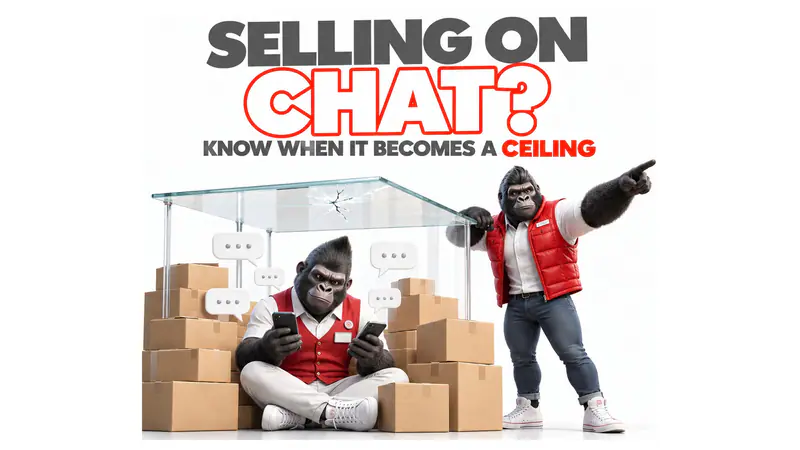

At the end of the month, marketing is often the first line people look at to cut. It is easy to see what was spent and hard to see what came back. So it starts to feel like a cost that never ends, and every new proposal is met with the same question: what will this bring us this month?
The image says “marketing is an investment for the future, not an expense”. We agree, with one condition that the slogan leaves out: marketing is only an investment when it is planned and measured like one. The same amount of money can be either. This article gives a simple test to tell which one a budget is, a way to review it, and a full example of moving from one to the other.
In short: Marketing is an investment when each part of the spend serves a named business goal, is measured from day one, and leaves something behind that keeps working: a known name, a clear position, content, reviews, a customer list. Without those, the same money is an expense. A healthy plan funds both quick sales and slower brand-building, in a balance that fits the stage of the business.
Two kinds of return
The most useful research on this question is Les Binet and Peter Field's The Long and the Short of It (IPA, 2013), built on many years of campaign data submitted to the IPA Effectiveness Awards. Their central finding is that marketing works on two timescales. Sales activation, such as offers and search ads aimed at people already looking, pays back quickly but fades as soon as it stops. Brand building, which makes the name known and liked by people who are not buying yet, pays back slowly but keeps working and makes future activation cheaper.
They found that, on average across their data, campaigns that gave the larger share of budget to brand building, roughly sixty percent against forty for activation, tended to be more effective over time. They are clear that the right balance varies by category and situation. The point for a smaller business is not the exact split. It is that spending only on this month's sales means paying full price for every customer, forever. Byron Sharp's How Brands Grow (2010) reaches a similar place from another direction: brands grow when many buyers find them easy to recall at the moment of need, and that recall has to be built before the moment arrives.
Expense or investment? A four-question test
Run every line of the marketing budget through these four questions. A line with two or more “expense” answers is worth questioning before the next payment.
| Question | Expense answer | Investment answer |
|---|---|---|
| Which business goal does it serve? | “To be present” | A named goal: new patients, repeat orders, a new market |
| How will we know it worked? | Likes, or nobody knows | A measure set before spending |
| What is left when it stops? | Nothing | A known name, content, reviews, a customer list |
| What did we learn for next time? | Each month starts from zero | The next plan builds on this one |
Turning a budget into an investment, step by step
- A spend sheet. Every marketing cost of the last twelve months on one sheet: ads, agencies, freelancers, printing, events, discounts, tools. Discounts count; they are marketing paid in margin.
- A goal for each line. Next to each line, the business goal it served. Lines without one get flagged.
- A split. Mark each line as activation (sales now), brand (being known and remembered) or asset (something that keeps working, such as a website, photography or a customer list). This shows where the balance really sits.
- A measurement plan. For activation: enquiries, bookings and cost per customer. For brand: people searching for the name, direct enquiries, and new customers who say they already knew it. For assets: how often they are reused.
- A rebalanced plan. Cut or fix the flagged lines, protect what is working, and move part of the saving to the side that is missing, usually brand or assets.
- A review date. A fixed quarterly review against the same measures. Without it, the plan quietly turns back into an expense.
A worked example
This example is hypothetical, and its numbers are only there to show the method. A dental clinic in Dubai has spent steadily on marketing for two years. Bookings are reasonable, but the partners feel the money disappears: the cost of each new patient keeps rising, and every time the ads pause, bookings drop within weeks.
The spend sheet shows that most of the budget goes to social ads promoting a whitening discount, a smaller part to search ads, some to paid posts by lifestyle influencers, and a little to printed flyers. Goals and measures are mostly missing: the influencer posts were never tracked, and nobody knows how many discounted whitening patients came back for anything else. The split is almost entirely activation. Nothing is building the name.
The clinic does have one hidden asset: a team of dentists patients like, and a long list of past patients nobody contacts. The rebalanced plan keeps search ads for high-intent needs, where people are already looking for a dentist, and measures them by bookings, not clicks. It stops the untracked influencer posts and reduces the whitening discount, which mainly attracted one-time bargain seekers. Part of the saving goes into assets: real photos and short videos of the team, a booking page that works on a phone, a steady way to ask satisfied patients for reviews, and check-up reminders to past patients by WhatsApp. Another part goes into a consistent presence in the clinic's neighbourhood, built around one clear idea, for example calm, unhurried care for nervous patients, always within the rules that apply to healthcare advertising.
The measures change too. Each quarter the partners look at cost per booked patient, the share of bookings that come direct or by name, returning patients from reminders, and the number of new reviews. The first quarter may not look dramatic. But a year later, the clinic can pause an ad without bookings collapsing, which is the clearest sign that part of the spend has become an investment.
Five mistakes that turn investment into expense
- Cutting brand first when money is tight. It happens because brand effects are slow, so cutting them shows no immediate damage. The damage comes later, as every sale gets more expensive. Trim weak lines across the plan instead of removing one side entirely.
- Judging everything by this month's sales. It is the number the business feels most. But brand work cannot pass a one-month test. Give each line the measure that fits its job.
- Measuring only the last click. Ad dashboards credit the final ad before the sale, so everything else looks useless. Ask new customers how they first heard of you, and look at searches for the name.
- Renting attention, never owning anything. Ads and paid posts stop working the day payment stops. Make sure part of every budget builds something the business keeps: content, reviews, a customer list, a site.
- Starting without a baseline. Without a “before”, no result can be proven, and the next budget conversation is an argument. Write down today's numbers before changing anything.
When the long view is not the right call
If cash is so tight that the business may not be here in six months, short-term activation is the right priority, and we would say so. If the business cannot serve more customers well, because of capacity, stock or quality, more demand of any kind will hurt. And if marketing is not the bottleneck at all, a better plan will not fix the numbers; our article on finding what slows a business down helps tell the difference. Finally, if what is needed is simply someone to run a few ads, a specialist freelancer may be the more sensible choice than a full planning engagement.
How OG plans marketing as an investment
- See what the money is doing now. If marketing is already running, a marketing audit goes through the spend sheet and the test above in depth. What you get: which lines pay back, which do not, and what is missing.
- Build the plan. Marketing strategy and planning: the business goal, the customer, the balance between activation and brand, the assets to build, and how each part will be measured. What you get: a plan that can be defended line by line.
- Set up measurement before spending. Analytics and conversion tracking, plus simple habits like asking new customers how they heard of you. What you get: a baseline and a way to see what returned.
- Run it, or run it with your team. From content to advertising and WhatsApp marketing, or beside your team as an outsourced marketing team, with a regular review against the plan. What you get: each period building on the last.
Since 2013 we have planned marketing for more than 230 clients in 9 markets, from Cairo and Dubai. There are no fixed packages; the scope follows the need, and sometimes the most useful thing we do is recommend spending less.
The strongest objection
“We are a small business. We need sales this month, not a brand in three years.” That is fair, and for a business under real cash pressure, activation should come first. But the choice is rarely all or nothing. Many investments also help this month: reviews, a booking page that works, reminders to past customers, photos of the real team. Start there. They cost little, they bring sales now, and they are still working next year, which is what makes them an investment.
Built on: our planning work with clients since 2013; Les Binet and Peter Field, The Long and the Short of It (IPA, 2013); Byron Sharp, How Brands Grow (2010). The balance between short and long term varies by business. The dental clinic is a hypothetical example.
Before closing this page
- Which business goal does each line of the marketing budget serve?
- What share of last year's spend was activation, brand and assets?
- If all ads stopped tomorrow, what would keep bringing customers?
- Which numbers were written down before the last campaign started?
- When is the next review of the plan, and who owns it?