
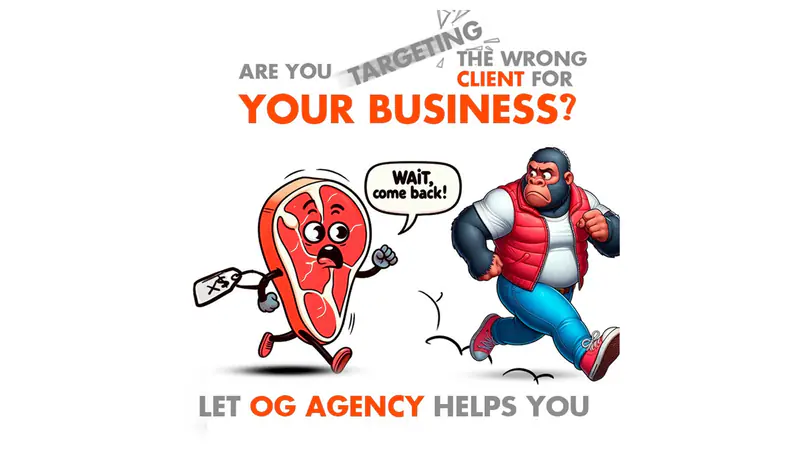
The ads are running and the messages keep coming. Most of them ask one thing: how much? Then they compare, go quiet and disappear. The few who do buy want the smallest order, the longest payment terms and the most changes. Meanwhile the customers who would pay for quality and come back every month never hear about you.
The question on the image asks whether the business is targeting the wrong client. It is a common problem and an expensive one, because it does not look like a targeting problem. It looks like “the market only cares about price”. Usually the market has several kinds of customer in it, and the marketing is talking to the wrong one. This article shows how to find the right one, with a scorecard, a method and a full example.
In short: “Everyone” is not a target. The right customer values what you do best, can pay for it, can be reached, and comes back. Finding them starts with your best current customers, not with a guess or a demographic. Once the target is clear, the message, the channel and often the offer all change, and so does the quality of the enquiries.
Why businesses end up chasing the wrong customer
Nobody chooses the wrong customer on purpose. It happens slowly, for a few reasons:
- Ad platforms optimise for what is cheap. They find people who click and message, not people who buy and return. Left alone, the cheapest leads come to dominate.
- The first customers set the habit. Whoever bought in year one shaped the message, the prices and the channels, even if the business has since changed.
- Fear of saying no. Narrowing feels like losing sales, so the message stays broad, and broad messages attract the people who compare on price.
- Targeting by demographics. Age, gender and city are easy to choose in an ad tool. But two people with the same profile can buy for completely different reasons.
Customers buy for a job, not a profile
Clayton Christensen and colleagues put this well in “Know Your Customers' Jobs to Be Done” (Harvard Business Review, 2016): people “hire” a product to make progress in a specific situation. The useful question is not “who is the customer?” but “what were they trying to get done when they chose us?” Two very different-looking companies may hire you for the same job; two similar ones may hire you for different jobs. The job is what the target should be built on.
Geoffrey Moore's Crossing the Chasm (1991) adds the second idea: for a growing business, it is safer to win one well-defined group completely, his “beachhead”, than to win a little of everyone. A group that knows each other refers each other, and the next group is easier from there.
The right-customer scorecard
Use it on any customer group, current or possible. A group that scores well on all five is worth focusing on. A group that fails on the first two rarely becomes profitable, however much is spent on reaching it.
| Criterion | Good sign | Bad sign |
|---|---|---|
| Values what we do best | Asks about quality, reliability or fit first | Asks only “how much?” |
| Can pay for it | Accepts the price once value is clear | Needs a discount to start |
| Can be reached | Gathers in known places, channels or events | Scattered, no shared place |
| Comes back | Repeat need, monthly or seasonal | One-off purchase |
| Easy to serve | Clear brief, few surprises | Endless changes, late payment |
Finding the right customer, step by step
- A ranked customer list. List last year's customers with revenue, number of orders, and how hard each was to serve. Sort by value, not by size of the first order. The top fifth is where to look.
- A one-page pattern. For the top ten, note what they have in common: their situation, the trigger that made them look for a supplier, who decided, and where they found you. Ignore anything that does not repeat.
- Five job interviews. Talk to five of the best customers about the moment they chose you: what was happening, what they tried before, what almost stopped them. Rob Fitzpatrick's The Mom Test (2013) is a good guide: ask about what happened, not about opinions or future intentions.
- A lost-deal review. Go through the last twenty enquiries that did not buy. Score each one on the scorecard. This shows how much of the marketing is reaching people who were never going to be good customers.
- A written target. One paragraph: who they are, the job they hire you for, the trigger moment, and where to find them. Add one line on who you will stop chasing.
- One small test. One message written for that job, in one channel where they gather, for a fixed period. Measure the quality of enquiries, not only the number.
A worked example
This example is hypothetical, and its numbers are only there to show the method. A supplier in Cairo prints branded paper cups, bags and boxes for food businesses. Its Facebook ads bring a steady flow of messages, mostly from new cafés and home kitchens asking for small quantities and the lowest price. Margins are thin, artwork changes are endless, and the sales team is tired.
The ranked list tells a different story. Of roughly eighty customers last year, about a dozen account for well over half the revenue. Almost none of them came from the ads. They are small restaurant chains and cloud kitchens with several branches, and most found the supplier through a referral or a trade fair. The pattern: they order every month, they have a procurement person, and the trigger was always the same: a previous supplier delivered late or the print quality varied between batches.
The five interviews confirm the job: “I need the cups to look the same in every branch and arrive before we run out.” Price came up, but later. The lost-deal review shows that most of the twenty lost enquiries fail the first two rows of the scorecard: they wanted a few hundred pieces and compared only on price.
The written target becomes: multi-branch food businesses in Greater Cairo that need consistent print and reliable monthly delivery. The supplier stops boosting “cheapest cups in Cairo” posts. Instead, it sends a short case-style message to procurement managers on LinkedIn, offers a sample pack that shows colour consistency across batches, and takes a stand at a food-service trade fair. New cafés can still order, through a simple standard range, without taking the sales team's time. The number to watch is not messages per week. It is how many enquiries come from businesses with more than one branch.
Five mistakes that keep the wrong customer coming
- Judging marketing by the number of leads. It is the easiest number to report, so it becomes the goal. Judge by leads that match the scorecard, and by what they are worth over a year.
- Writing for everyone “just in case”. A broad message feels safer but reads as generic. Write for one job; others who share it will recognise themselves.
- Asking customers what they want. They answer politely and vaguely. Ask what they did and what happened instead.
- Fixing the target with a lower price. If price-shoppers dominate, cutting the price attracts more of them. Change who the message speaks to first.
- Dropping the old customers abruptly. The aim is focus, not rejection. Give the less profitable group a simpler offer that costs little to serve.
When targeting is not the problem
If even the best customers buy once and leave, the issue may be the product or the service, not who is targeted. If the right customers are reached but do not reply, the offer or the follow-up may be the brake; our article on finding what slows a business down covers that. And if the business has very few customers yet, there may not be enough data for a pattern; in that case the first job is talking to the market, and market research fits better than segmentation. We would rather say this on the first call than sell the wrong study.
How OG helps find the right customer
- Look at what is already there. We start with the customer data that exists, ranked by value. What you get: the first picture of who your best customers really are.
- Talk to customers and lost buyers. Through customer research and segmentation, we interview both. What you get: the jobs, the triggers and the words customers use, and a short list of groups worth targeting, scored honestly.
- Turn the choice into a plan. Marketing strategy and planning puts the message, the channel and the offer around the chosen group. What you get: a plan your team can follow, including who to stop chasing.
- Reach them and measure. When needed, advertising, exhibitions or direct outreach, measured by lead quality. What you get: evidence that the target works, not only more messages.
Since 2013 we have worked with more than 230 clients across 9 markets, from Cairo and Dubai, in both consumer and business markets. There are no fixed packages; sometimes the interviews alone are enough, and we say so.
The strongest objection
“If we narrow down, we lose sales.” In the short term, maybe a few. But narrowing the message is not refusing customers. Others can still buy, through a simpler offer. What changes is where the effort and the budget go. And the sales that are lost are usually the ones that cost the most to win and the least to keep.
Built on: our customer research and segmentation work since 2013; Clayton Christensen, Taddy Hall, Karen Dillon and David Duncan, “Know Your Customers' Jobs to Be Done”, Harvard Business Review (2016); Geoffrey Moore, Crossing the Chasm (1991); Rob Fitzpatrick, The Mom Test (2013). The packaging supplier is a hypothetical example.
Before closing this page
- Who are the ten most valuable customers of last year, and what do they have in common?
- What job did they hire the business for, in their own words?
- Where did those customers first find the business, and is the budget there?
- Of the last twenty lost enquiries, how many would have been good customers?
- Who is the business ready to stop chasing?